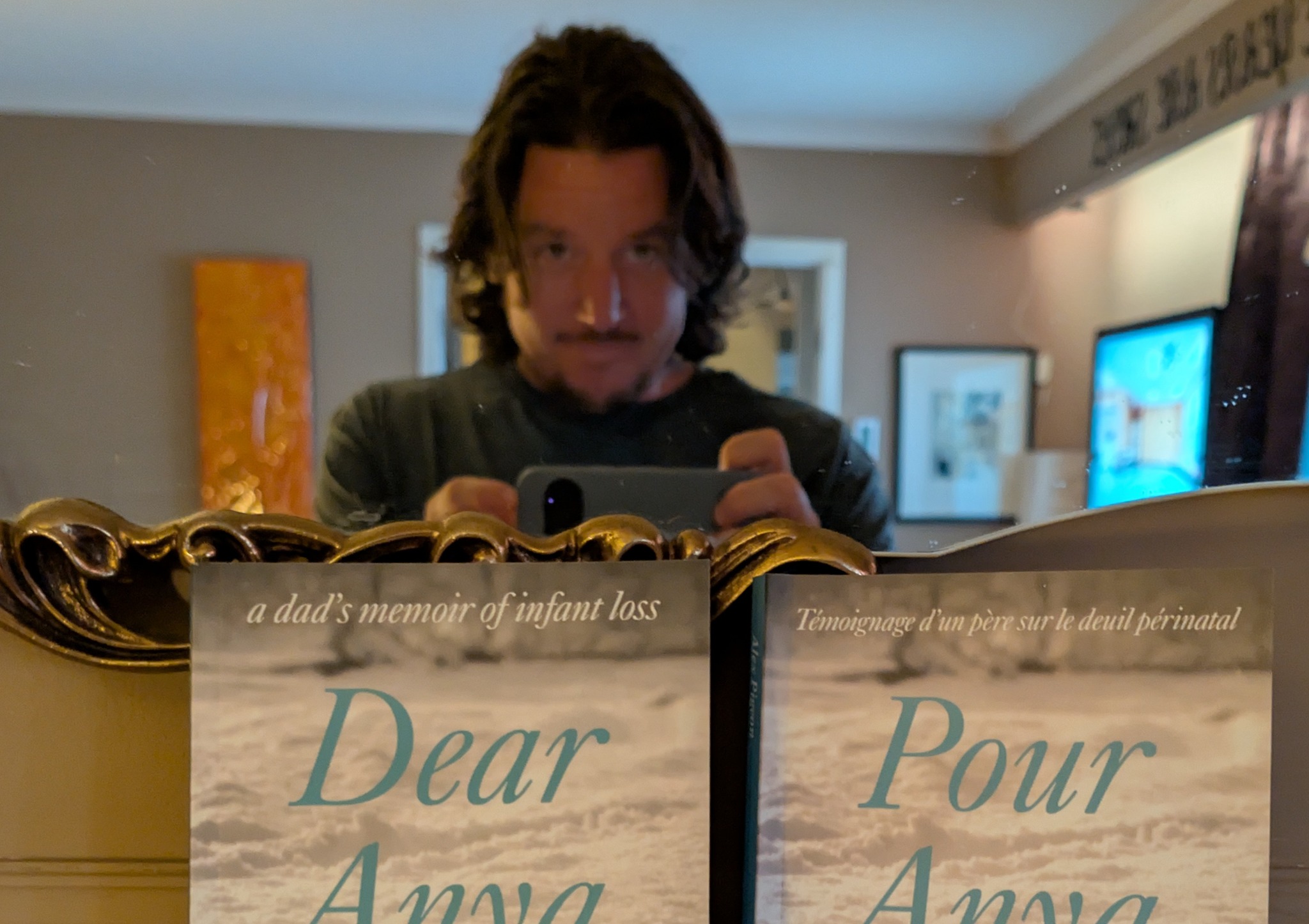
Writing a book can't be that hard, can it? When I set out to turn this dream into a reality, I figured the hardest part would be, you know, the writing. As it turns out, there were three parts that were harder: the reading part, conducting the follow-ups I felt were necessary, and then the actual publishing part.
It's interesting to look back at the version history to see the path this project took. It began in mid-August 2024, with a single page showing a title I eventually abandoned (Still Dad). In September 2024, I came up with the original outline, shared below and contrasted with the final outline.
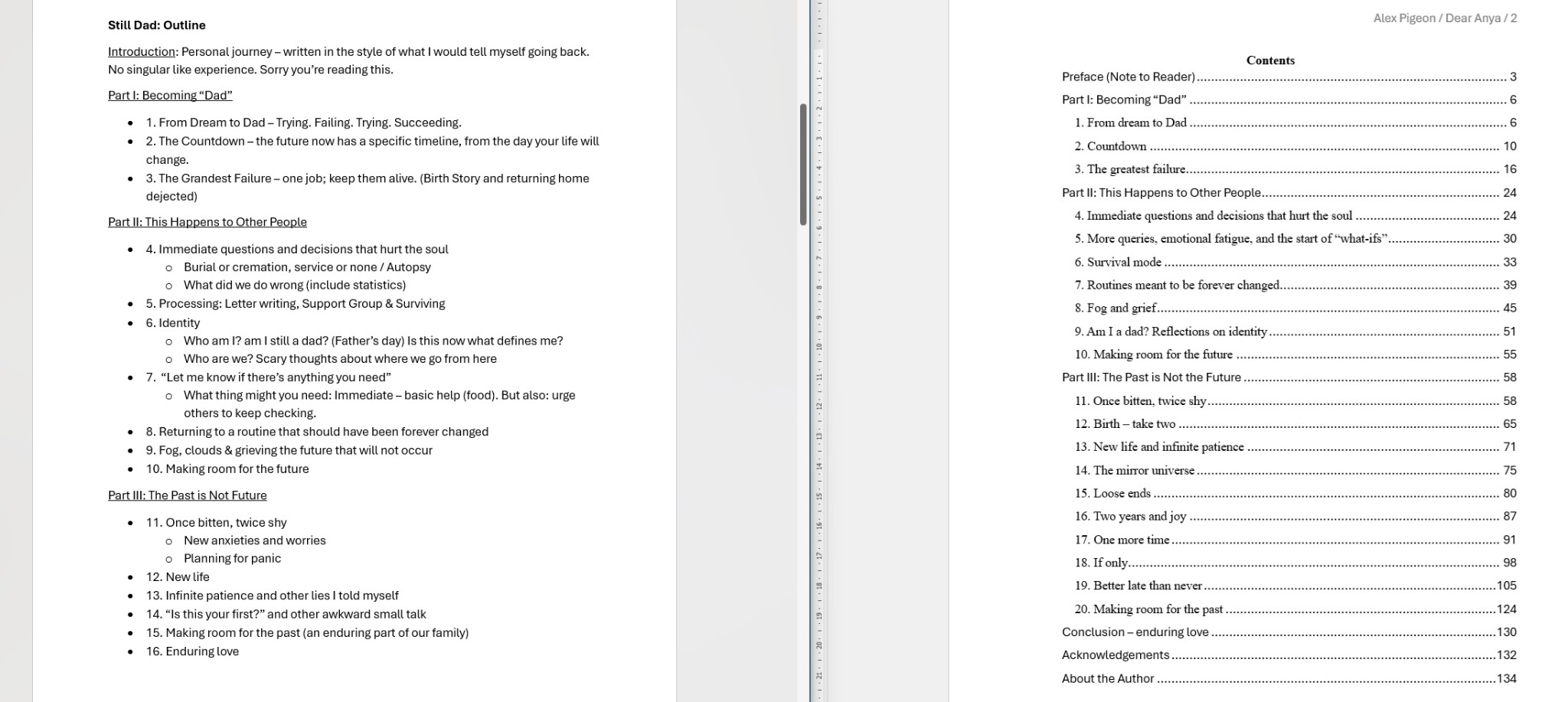
My original vision for the book was to make it more about my present-day self giving my past self advice I thought I could have benefited from hearing. The title Still Dad was a nod to that concept: When I was questioning whether I had any right to call myself ‘dad’ in writing my first letter to Anya, I would respond to that feeling by telling myself: of course you did. It was also an acknowledgement of the stillness of Anya after being born, even if she was not technically a stillbirth.
While those types of reflections did make it into the final version, as an overarching concept it didn’t really work. There were a lot of moments, when I started to fully and completely relive the story, where really there wasn’t additional advice to be had that would be helpful. Eventually, it became clear that just the telling of her story as a memoir was powerful. So Dear Anya became the title – in part as a nod to the many letters I had written to her, but also because that is really who she is to me, and to us. She is dear. Her memory, her presence. That is the feeling and the word that feels most associated to her in my mind. Overall, though, it’s interesting that the structure did generally end up following that original outline.
Hard part number one: Reading
Before I really got into the writing, I had a lot of reading to do. I needed to go back and re-read every word and every thought I had about Anya in order to really put myself in the mindset I felt this book deserved to do her justice. That included not just re-reading every blog post, but every message of support we received, all of the messages of support Kayleigh and I hand-wrote to each other, and every photo I took during the pregnancy. I would be lying if I said that this didn’t take a particular emotional toll. It was a difficult, but ultimately worthwhile price to pay.
The writing process
On May 12, 2025 – the first day of my six-month unpaid leave from work, I really got started. I began by writing an outline for each of the chapters, sketching out the key parts of the timeline, and the key questions or concepts I wanted to tackle. Nothing too lengthy – three or four bullets, just enough to give each chapter a general vision and direction. By May 17, spending (at times) a good six to eight hours a day focused on this project, I had already written 11,000 words – roughly a quarter of what the final book length became. By May 26, I was up to 26,000 words and had completed the initial draft for each of the originally-planned chapters (with certain portions still needing to be more fully fleshed out). For the most part, I felt that the initial draft poured out of my heart, without hitting major road blocks.
Hard part number two: Follow-ups
The biggest missing pieces after I finished that first draft were those that related to follow-ups I felt I needed to make to really get the closure I realized I never got surrounding the Coroner’s Report’s recommendations. I went into many of those details in my December 2025 anniversary post, but in summary they involved reaching out to the birthing centre where Anya was born, and with the Bureau du coroner, in order to get the details I thought I deserved. Eventually, those follow-ups led me to also engage with the Ordre des sages-femmes.
By that anniversary, I had gone back to work and did not have the mental or emotional energy to throw myself back in (re-reading everything from scratch), so I began to think of it in two tracks: I would publish the version of the book I had, which detailed my initial conversations with those organizations (and which answered my basic questions), and I would separately continue my follow-ups on the more systemic issues that had by then become clear to me as a separate way I would continue to carry Anya’s legacy forward. Those follow-ups would ultimately only wrap up in mid-March 2026, almost a year after I began writing.
Hard part number three: Publishing
How does one bring a book out into the world in practice? At first, I decided to try to go the traditional-route. It was very interesting to learn that you do not directly approach potential publishers with a manuscript. The first step is to secure a literary agent, who will do a pitch on your behalf. Perhaps not surprisingly, one of the most important factors considered by both agents and of course publishers is commercial potential. This topic, this niche, by an unproven author is not one that is easy to pitch as having a whole lot of commercial potential, especially when I do not have a claim to fame of a bazillion existing followers. I did try for a couple of months. An excellent series I absolutely recommend on book publishing from NPR’s Planet Money helped me finally understand the longshot that I was up against in this traditional route, and that I needed to change tactics if I wanted to bring this book out in the world anytime soon.
Self-publishing became the alternative route, but one that was quite daunting for different reasons. Ensuring that every detail was looked at carefully was up to me. I had to hire a professional editor. I had to secure permission to use Anya’s photos. I had to methodically and carefully ensure the formatting, spacing, capitalization, and many other details were checked, re-checked and triple-checked. I had to translate every sentence into my Franco-Ontarian voice, and methodically conduct the review and re-review in French (aside: did you know there is such a thing as a ‘non-breaking space’ character that is used to make sure that things like French quotation marks stay on the same line?) I had to figure out how to do the interior formatting (I ended up using a software called Atticus). I had to register with Library and Archives Canada in order to be able to generate ISBN numbers. I had to make this author website. I had to hire a book cover designer. I had to figure out where and how one self-publishes (there are a few options, but ultimately I went with the Amazon print-on-demand solution as the most practical one; as much as I hesitate to use Amazon generally these days).
Wrapping it up
I did not get a chance to dedicate a significant block of time to this project (the kind of time needed to dive back in emotionally) until I went on vacation this past July 2026. By then, I had wrapped up my separate follow-ups, and it did not really make sense to leave them out of the story, because they did bring a significant amount of closure. That meant going back to writing, though, and creating what ultimately became the chapter ‘Better late than never’. In the end, the story reads better with the addition of that chapter – it became more chronological, and avoided jamming details related to the follow-ups inside the chapter that was about the Coroner’s Report.
I'll admit, though, I did seriously debate abandoning the project altogether as recently as July. I was daunted by all the things that still remained, and asked myself whether I was potentially putting something out into the world that would just make people feel sad. Ultimately, returning to a sentiment I expressed early in the book (that I had hoped I could have read a story like this in those early days), and wanting to show William and Juliette the importance of perseverance, I kept going.
I am very proud of the final product. In total, I have poured hundreds of hours and a massive amount of love into it. I cherished the chance to be Anya’s dad once again in writing it, as much as it took an emotional toll at times. I really hope this telling of our journey will help someone, somewhere, as they learn to navigate the world with a broken heart.
Dear Anya: A Dad’s Memoir of Infant Loss (and its French translation, Pour Anya : témoignage d’un père sur le deuil périnatal) is out today. Dear Anya is available from Amazon in paperback and on Kindle. Pour Anya is also available in paperback and on Kindle. Should you think this might help someone in your life, I will happily provide a courtesy digital copy upon request at alex@alexpigeon.ca.
Thank you for reading it. I look forward to hearing your thoughts.